Poem in Anthology, This Gift, This Poem

Andrew’s poem, “The Homecoming”, has been published in the anthology, This Gift, This Poem, edited by Jean Kent, David Musgrave, Carolyn Rickett and Jen Webb, and published by Puncher & Wattmann.

When the editors wrote to Andrew requesting a poem in March 2021, they explained that “the motivation behind this current project is to create a collection of poems which would serve as a gift for people in hospital, and for their loved ones and carers who may be supporting them during the anxieties of illness.”

Judith Beveridge states in the book’s blurb,

One of poetry’s chief purposes is to draw people together. It has always been a means for communicating stories, beliefs, customs, and values of a people. In moments of crisis, we turn to poetry because it has that unique ability to express and formalise emotion, to bring something of ourselves into being. This anthology, This Gift, This Poem, does exactly that, keeping readers in its tender yet bracing hold. …

Copies of This Gift, This Poem can be purchase via the publisher’s website, here – https://puncherandwattmann.com/product/this-gift-this-poem/.

After accepting Andrew’s poem, the editors asked for a “Reflection” to accompany it. Both are reproduced below:

The Homecoming

……….1
Restraint

As the car pulls up
the pup goes prancing to the door
to greet my grandkids.
Though I stay put, I too feel like
yapping and rolling on the floor.

……….2
Anticipation

I hear the dog greet
my grandchildren in the drive.
Shortly, they’ll enter
my study with jostle and shove
and paw at me for scraps of love.

Reflection

Two things came together to move me to write “The Homecoming”. First, my wife, Susan, and I were looking after our grandchildren in their own home while their parents were overseas. Second, a close friend, Hal Colebatch, died and his widow, Alexandra, asked me to conduct his funeral service and to deliver the eulogy. While working on the eulogy one afternoon, I heard the children’s dog go berserk with excitement as Susan drove into the carport, bringing the children home from school. And, like the dog, I felt a flood of anticipation and happiness, emotions so at odds with the ones I had just been experiencing. I immediately felt an urge to try to capture some sense of this joy, this gladness, in poetry. So I began work on several short poems—poems modelled on the ancient Japanese poetic form known as the tanka (or, waka), which consists of 31 syllables arranged in five lines of 5, 7, 5, 7, 7 syllables respectively. Over the next few days, I wrote half-a-dozen tanka, and finally settled on the two that now sit together to comprise the poem, “The Homecoming”.

© Andrew Lansdown

Poem in Antipodes (USA)

The American literary journal, Antipodes, has published one of Andrew’s poems. “Light Observations”, a set of eight light-hearted haiku, appears in Vol. 34, No. 2, December 2020 issue of Antipodes. The middle two haiku are:
……….iv
The ram paddock—
a gathering of Scotsmen,
sporrans swinging.

……….v
Glorious racket—
one million frogs hollering
or one megafrog?

© Andrew Lansdown

Tennyson on Russia’s 1790s Invasions of Poland

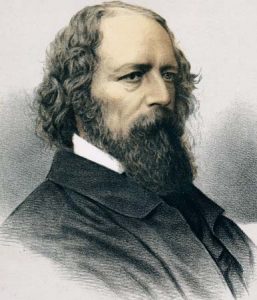
Given the present depredations of Russia against the Ukraine, Alfred Tennyson’s sonnet, “Poland”, seems hauntingly relevant.
Published in 1830, the sonnet deals with the Russian invasion of Poland in 1792 and Russia’s suppression of the Polish Uprising of 1794.


Poland

How long, O God, shall men be ridden down,
And trampled under by the last and least
Of men? The heart of Poland hath not ceased
To quiver, tho’ her sacred blood doth drown
The fields; and out of every smouldering town
Cries to Thee, lest brute Power be increased,
Till that o’ergrown Barbarian in the East
Transgress his ample bound to some new crown:—
Cries to thee, ‘Lord, how long shall these things be?
How long this icy-hearted Muscovite
Oppress the region?’ Us, O Just and Good,
Forgive, who smiled when she was torn in three;
Us, who stand now, when we should aid the right—
A matter to be wept with tears of blood!

Alfred, Lord Tennyson

4 Poems in Quadrant

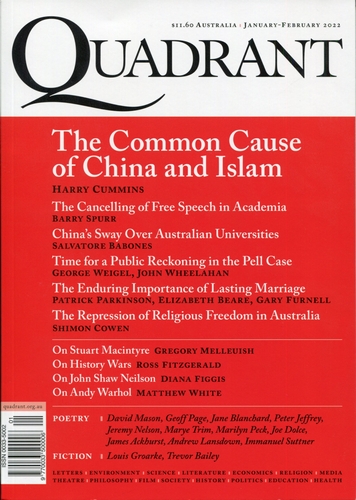
Four of Andrew’s poems have been published in the January-February 2022 issue of Quadrant magazine. The poems are: “The Liminal Child”, “Night Petals”, “The Girl and the Papyrus” and “She”.

Dedicated to Andrew’s wife, Susan, the poem “She” consists of four stanzas, each rhyming ababb and structured like the traditional Japanese tanka (with 31 syllables arranged in 5 lines of 5,7,5,7,7 syllables).

She

for Susan

I now realise
she’s elect among ladies.
With my very eyes
I’ve seen her banish maybes,
bless God and suckle babies.

She can oversee
governments, griefs and gravies.
Given a chance, she
would heal the wolves of rabies
and quell the guns of navies.

She is the ropes
upon which my life rappels.
To her my hopes
cling like the claws of grapples,
rise like the spires of chapels.

She’s a world apart,
all daylight without dapples.
So help my dry heart,
she sets alight the maples
and adds the juice to apples.

© Andrew Lansdown

Review of Abundance in Studio

.

Andrew’s latest book, Abundance: New and Selected Poems, was reviewed by Ian Keast in Studio magazine, No. 153, 2021. The review begins:

It was 1980. I was in Sydney for a Conference, and browsing in one of my favourite bookshops which carried a substantial collection of poetry. “You must read this. He’s one of your believing lot. It’s a fantastic collection.” The bookshop owner handed me, Counterpoise, by Andrew Lansdown, just published. From conversations over several years, I knew he held views that were somewhere ‘to the left of Lenin’, so his opinion of Lansdown’s book was a real and very generous endorsement. “Read the title poem. That last stanza is such a marvellous statement.”

The title poem of his first major volume of poetry, Counterpoise, (and the first selection in Abundance), provides a good introduction to Lansdown’s work. The poem speaks of light on rivers, jellyfish, children, grandparents, prawning. Simple ordinary things that point to the certainties and strengths in life. The poem concludes,

How ignorant I have been
through these last years of learning,
how weighted down on one side of the scale.
The large, deep things are all
in their own ways dark and hard.
Small things are a counterpoise
to lighten and soften the heart.

‘Counterpoise’—balancing two different realities—is central to Lansdown’s poetry, both in its style and content. He has a simple, ordinary observation, which—in counterpoise—often produces deep insight. His language is clear and precise, in Les Murray’s words, “he is an imagist of almost unlimited inventiveness”. Once evoked, the reader’s imagination and thinking, can—in counterpoise—be extended beyond the poem to explore further the associations raised. It is this counterpoise of being accessible and profound, which provides the essence of Lansdown’s poetry. …

To read the rest of Ian Keast’s review, go to the Reviews page on this website.

To read publication details of Abundance and sample poems, go the Poetry pages on this website here.

Abundance can be purchased with PayPal on the Buy Books page on this website.

Poem in Eucalypt


Eucalypt: A Tanka Journal
has published one of Andrew’s tanka, in Issue 31, 2021. It is reproduced below in the magazine’s style, without title or capitals:

but how could she know,
the child yanking her hand free
from her grandmother’s:
soon enough she might be left
with nobody’s hand to hold?

© Andrew Lansdown

Poem and Tribute in Studio


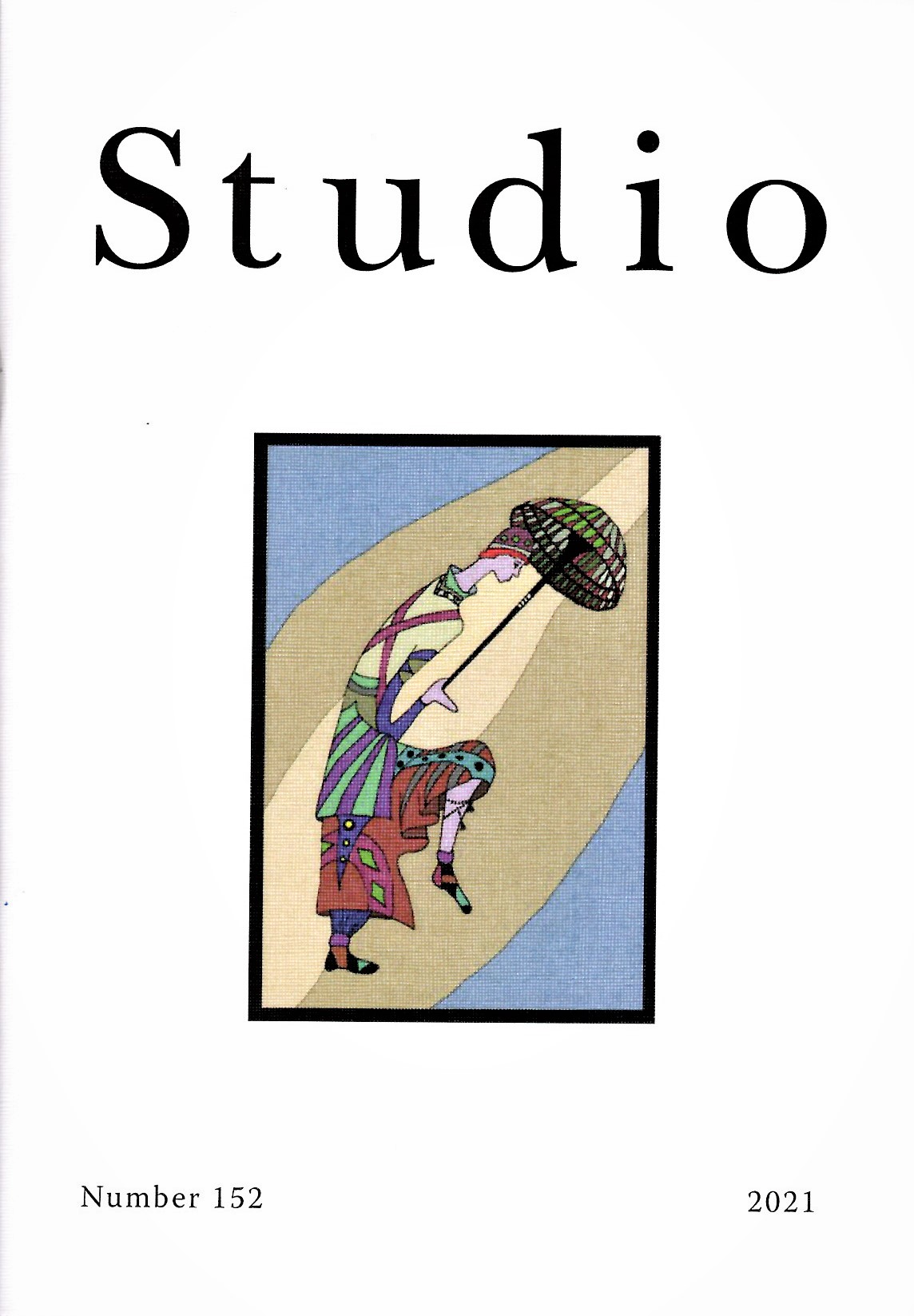
The latest issue of Studio (# 152) contains a poem and a tribute by Andrew.

The poem, “Vikings”, is dedicated to the late Western Australian poet, novelist and social commentator, Hal G.P. Colebatch.

The tribute is also for Hal, and was delivered by Andrew at the Memorial Service held for him on 23 September 2019.

The text of the “Tribute for Hal Colebatch” can be read on this website here.

Poem in Rabbit


Andrew’s poem “Zuiho-in Zen Temple, Kyoto” has been published in the latest issue (# 33, 2021) of Rabbit: a journal for nonfiction poetry.

The poem is dedicated to the memory of Sorin Otomo, a warlord who founded the Zen temple in Kyoto in the sixteenth century AD and later converted to Christianity.

In recognition of Sorin’s Christian faith, one of the dry landscape gardens at the temple has seven stones positioned to from the shape of a cross.

Review of Abundance: New and Selected Poems


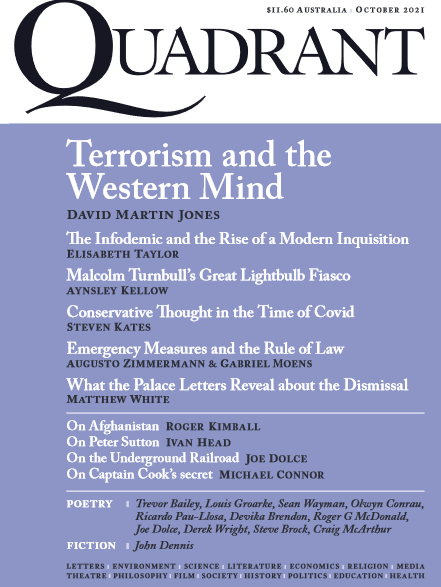
The October 2021 issue of Quadrant magazine contains a review of Andrew’s latest book, Abundance: New and Selected Poems (Cascade Books, USA).

Under the heading “Searching the Poetic”, Ivan Head reviews four collections of poetry, Abundance being the second in the set. His generous and erudite review begins:


Metre and notes also need not be far away when turning to Andrew Lansdown’s wonderful book Abundance: New and Selected Poems. Not that the pursuit of either need detract from the splendid accessibility of this large and carefully chosen collection. For instance, “On Poetry”, the second poem, and reprinted from Counterpoise (1980), carries a dedication to William Hart-Smith, who had a significant influence on West Australian poets. Immediately, one can use the marvels of the net to track material on Hart-Smith and the interaction between these two and other poets before returning to the poetry itself. At the end of “On Poetry”, Lansdown writes of his infant son, not yet walking but sitting on his knee as he talks with Hart-Smith:

my son …

spasmodically stops
our talking with

a short sigh,
and lifts and drops

his foot rhythmically
on the flat of my thigh.

Lansdown is a poet of the embodied and deeply-observed world and, in the end, metre and rhythm in poetry will have more than a close relationship to the beating heart, the dancing feet and all human movement. It is a kind of incarnationalism. Auden’s persona in “The Shield of Achilles” was also looking for figures dancing. To read Lansdown’s new book is to become open to a much wider world.

One earlier publication, Abiding Things, is not represented in this volume. I note that critics of that book said significant things about Lansdown. Les Murray wrote in the Sydney Morning Herald: “He espouses … an aesthetic of small observations”. Rod Moran in the Fremantle Arts Review wrote of Lansdown “lifting the veil of familiarity from the world”, and Philip Salom in the West Australian called him “an imagist of the highest order”.

Micro-observation can go hand-in-glove with a larger metaphysic, even an off-stage metaphysic that is made by the poet’s mastery of the art to serve the poetry, and where the poetry is not a convenient footstool for other concerns that in the end dominate. In that sense of micro, there is something dense and condensed in Lansdown’s poems, a vision lurking. I’m happy to call Lansdown a metaphysical poet. Blake could write in an observational-micro that evoked London in detail, though perhaps his larger vision became obscure in the longer poems. They became seriously esoteric, seriously gnostic. …

Read the rest of Ivan Head’s review of Abundance here.