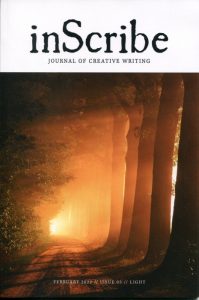
Christianity & Literature, a quarterly journal published by Johns Hopkins University Press (USA) for The Conferenceon Christianity & Literature, has published a review of Andrew’s latest poetry collection, Abundance: New and Selected Poems (Wipf & Stock/Cascade Books, USA, 2021). Written by T. M. Moore (writer, theologian and Principal of The Fellowship of Ailbe – https://www.ailbe.org/), the review is detailed and positive, and is reproduced on this website by permission of the author.
REVIEW by T. M. MOORE
Abundance: New and Selected Poems. By Andrew Lansdown. Eugene: Cascade Books, 2020. ISBN 978-1-7252-8457-9. Pp. xvi+225.
I was not familiar with Andrew Lansdown prior to reading this book, but I found his poems to be among the best I have read in many years. His mastery of form, variety of subject, precision of image, insight to everyday things, and buoyancy of hope and faith make reading his poems a delightful, satisfying, and enriching experience. Besides a few new pieces, the poems in Abundance are taken from eleven previous volumes of poetry, dating from 1980. They demonstrate a consistency of style, craftsmanship, lyric, and beauty that are marks of a very fine poet, one American readers and professors of literature would be pleased to know.
Abundance is a song book of wonder and gratitude. Its overarching theme is captured in the closing lines of “Grace”, from Lansdown’s 1993 collection, Between Glances (73):
“Let us give thanks.” And millions
at mealtime do. Even infants,
those most insouciant of souls,
offer thanksgiving with cries and cooing
as they nuzzle at the breast –
that guzzle-and-come-again fount
where form and feast fuse in bliss
and soft blessing. See how they tug
away from the nipple, smiling.
Eyes closed and heads bowed: it is
the only way to look up. Thank
You. And think of it, the dignity
we gain through humility. Being
grateful. Giving thanks. That precious
repetitious prayer that makes us remember
grace as we say it.
This is followed on the next page (74) by an even more succinct statement of theme, a poem entitled “Abundance”, which enlarges on the title of this collection:
The thing that astonishes me is that
life goes on abundantly without me…
[Here follow four stanzas, in which he celebrates various of the themes that run through his verse. The poem ends,]
Truly, it’s an astonishment,
this abundance independent of me
that touches me seemingly by accident.
Andrew Lansdown’s poems lead us into the mysteries, wonders, and beauty of creation; the joys, sadnesses, and uncertainties of relationships; the essentiality of family and community; the inevitability of death; and the hope of everlasting life in Christ. His work offers a worldview, by which I mean, a way of viewing the world that enables us to see through the everyday, mundane realities of our uncertain and underappreciated existence into the eternal beauty, glory, safety, and joy of our Creator and Lord. In his book, The Divine Conspiracy, the late Dallas Willard wrote, “By showing to others the presence of the kingdom in the concrete details of our shared existence, we impact the lives and hearts of our hearers, not just their heads. And they won’t have to write it down to hold onto it.”[1] This is what Andrew Lansdown does in abundance through his beautiful poems.
Lansdown writes as a formalist poet, though not slavishly so. He employs traditional forms but also fiddles with them a bit, creates new forms, and uses free verse as he pleases. He has also been greatly influenced by Japanese and Chinese poetry, and this volume reflects his love for those themes and forms as well. …
CONTINUE READING T.M. MOORE’S REVIEW HERE

 The online journal StylusLit has published Andrew’s poem, “About Emptiness”. Appearing in Issue 12 (September 2022), the poem is a set of three haiku on a common theme.

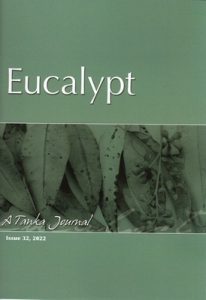 Issue 32, 2022, of Eucalypt: A Tanka Journal contains one of Andrew’s tanka, which is reproduced below (in the magazine’s style, without title or capitals):