Quadrant publishes Nicholas Hasluck’s launch speech for Andrew latest book

Nicholas Hasluck launched Andrew’s latest collection of poetry, Filling the Emptiness, at the State Reference Library in Perth on Sunday 9 February 2025. Nicholas’ speech was published in the May 2025 issue of Quadrant magazine, and is reproduced in this post.


Fresh Light on the Everyday

by Nicholas Hasluck


Nicholas Hasluck launched Filling the Emptiness (WA Poets Publishing, Perth, 2025, $25), at the State Library of Western Australia on February 9.

We are here to celebrate the launch of Andrew Lansdown’s latest book of poetry, Filling the Emptiness, from WA Poets Publishing. I have known Andrew as a friend and fellow poet for many years. I am therefore pleased indeed to have been offered the opportunity to launch the book and to say a few words about his work.

The title Filling the Emptiness is intriguing, because Andrew has been so prolific since his first book was published in the 1970s that it might seem to a newcomer to the poetry scene that the emptiness, if any, had been filled already. His book Abundance: New and Selected Poems lists fourteen previous poetry titles plus various works of fiction and non-fiction. But one must never think in numerical terms when approaching the work of a dedicated poet. Like most poets, Andrew is constantly striving to see familiar things in a new light or to reveal connections that aren’t usually perceived. From which it follows that a poet’s cornucopia is constantly changing shape and can never be entirely filled.

This emerges early on in Andrew’s title poem, “Filling the Emptiness”, in which the structure of a bamboo, the external beauty of it, the presence of its inner nodes or compartments, is used to suggest the ever-plentiful nature of the stories, real or imagined, that lie within. His poem, in the Japanese five-line tanka form, is presented to us in short sections, each of which, in a suggestive tone, points to hidden layers of meaning.

……….i

Even a bamboo
can only take emptiness
in little doses …
In the stem the nodes divide
the void into compartments.

……….ii

A white wafer
hidden in the dark hollow
of the bamboo—
a summons to communion
with the one who put it there.

……….iii

Empty lockets
are locked in the bamboo stem
at every node—
saw them free and fill them up
with portraits of ones you love.

I will have more to say in a moment about Andrew’s use of the cryptic Japanese tanka and haiku forms, which he uses to great advantage throughout the book as a means of picturing familiar things in a new way.

Before I do so, let me remind you, as I remind myself, that in a first encounter with a friend’s book one is often drawn immediately to poems touching on shared experiences. Music, for example. Taylor Swift and Beyonce may be names to conjure with in the music world these days but, sotto voce, I have to confess that personally I’m an unreconstructed jazz buff. I treasure vivid memories of visiting Preservation Hall in New Orleans and other iconic venues in Crescent City.

I was therefore drawn immediately to Andrew’s comical poem “Them Shoes” in which he describes raucous party-time revellers in Bourbon Street, New Orleans, beset by trumpet, trombone and tuba, boys tap-dancing for tips, until he is suddenly accosted by yet another denizen of the old French Quarter, a grifter with an alligator grin who points to Andrew’s unremarkable walkers and says: “Where’d you get them shoes?” The poem continues in this way:

Having hooked me, he reels me in with his spiel:
“I could tell you where you got them shoes.”

It’s a lurk, a rort, a trick, but how does it work?
I think of a shoe shop in my far-off homeland.

“Yeah?” I say, knowing he can’t possibly know,
yet knowing, too, he impossibly does. “Where?”

“First,” he says, “you gotta pay for a shine
if I can tell you where you got them shoes.”

“Ten bucks,” he says, when I ask how much.
I agree and ask, grinning, “Tell me where, then?”

He pulls a rag from his pants back pocket
and drops to one knee on the pavement.

Straight-off straight-faced he says: “You got them shoes
on your feet, and your feets on Bourbon Street.”

As he lifts my shod foot onto his knee,
laughter and one-leggedness unsteady me.

Then to the rhythm of his buffing,
in a mix of southern drawl and black jive,

he jibes, “You ain’t payin’ for the shine,
You is payin’ for the education.”

Even the price of the Louisiana Purchase
wouldn’t suffice to pay for my elation!

READ THE REST OF NICHOLAS HASLUCK’S SPEECH HERE.


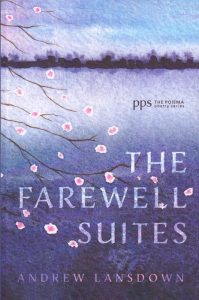
Review of Andrew’s book, The Farewell Suites

Quadrant magazine has published a review of Andrew’s book, The Farewell Suites., which was published in the United States by Wipf & Stock in 2024. Written by academic and editor Jill Ireland and titled “Durable Hope”, the review appears in the March 2025 issue of Quadrant. It opens:

The Farewell Suites treats a series of deaths in Andrew Lansdown’s family: a brother who died young, another who took his own life, a baby who died before birth, and his parents. While death may seem a forbidding topic for a collection of poetry, the poet’s sources of hope emerge as durable despite – or perhaps because of – his honest plumbing of the depths of his family’s experience.

The Farewell Suites has a simple and meaningful structure. Each person lost has their own suite of poems. This helps readers to get their bearings, and sit in silence after each to ponder what has been revealed about the individual who died and how they fit in the jigsaw of the family. The cumulative effect is very powerful.

The length, breadth and depth of the poet’s faith in God permeate every poem but this does not preclude doubt, misunderstanding, even bewilderment at the fact of death and its reverberating impacts. Lansdown’s words illuminate that frozen moment when knowledge of a death arrives and the remainder of life has to be readjusted in a split second, but also in each minute and day that follows, until we deeply recognise how life is without them, and can let go of the “What if…?” questions.

Lansdown is a master of his craft. He is a dedicated and intense observer, seeing the minute and the magnified in the curve of one petal, the corners of a coffin, or a child’s one-word question. He has an uncanny ability to distil the significance of a single moment.

One poem will illustrate how Lansdown captures an everyday occurrence and shows how death jolts it into a deeper meaning, in a moment of stillness and recognition.

Read the entire review on this website here:

Ten Poems in Six Issues of The Mozzie

Andrew has had ten poems published in six issues of The Mozzie from June 2023 to February 2024:

Volume 31, Issue 5, February 2024 – one poem: “Increments of Beauty”
Volume 31, Issue 4, December 2023 – two poems: “A Not-So-Nonsense Poem” and “Preventive Measures”
Volume 31, Issue 3, October 2023 – two poems: “Concerning Austerity and Creativity” (consisting of two tanka, “1. Inspirations for Ikebana” and “2. Ikebana Dreaming”) and “Violets” (consisting of three haiku)
Volume 31, Issue 2, August 2023 – three poems: “Locations of Red”, “Aboriginal Rock Art” and “Sculptors”
Volume 31, Issue 1, July 2023 – one poem: “Starlight” (four haiku)
Volume 30, Issue 9, October 2023 – one poem: “Zuiho-in Zen Temple, Kyoto”

Five poems in Quadrant


March 2023 issue of Quadrant contains five poems by Andrew. They are: “Getting Light”, “Hole”, “Pictures of Plants”, “The Calming Clams”, and “Locations of Red”. “Pictures of Plants” is a gunsaku, a set of six haiku on (as the set title indicates) the subject of plants.

“Holes” was written after a visit to a small graveyard in Kyoto, Japan, where women had left offerings before an idol of Jizo, a Buddhist Bodhisattva to whom women appeal to save their deceased children from a hell-like place called Sai no Kawar. The poem is reproduced below.


Holes

Japan: Jizō Bosatsu, guardian of the souls
of miscarried, aborted and stillborn children (mizuko)

A persimmon
left as an offering to
Jizo Bosatsu
has been holed by birds, just like
a mother’s heart, holed by grief.

Also without
a centre, a five-yen coin
offered to Jizo
by a mother aching to save
her mizuko from limbo.

© Andrew Lansdown

Nine poems in Seven issues of The Mozzie

Andrew had nine poems in seven issues of The Mozzie in 2022:

Volume 29, Issue 7, January 2022 — “Breakdown”
Volume 29, Issue 10, May 2022 — “Ukrainian Villanelle” (text of poem posted on August 12, 2022)
Volume 30, Issue 1, July 2022 — “She”
Volume 30, Issue 2, August 2022 — “Little Things” and “The Dunking Birds”
Volume 30, Issue 3, August 2022 — “Times of Fox-Dread”
Volume 30, Issue 4, October 2022 — “Petal Poems, Kyoto”
Volume 30, Issue 5, December 2022 — “Ninth Month”

“Ninth Month”, a light-hearted, imagist tanka, is reproduced below:

Ninth Month

A cement mixer—
the shape, of course, but even
the way while sleeping
she would toss about and turn
to keep our child on the churn.

© Andrew Lansdown

Poem in StylusLit

The online journal StylusLit has published Andrew’s poem, “About Emptiness”. Appearing in Issue 12 (September 2022), the poem is a set of three haiku on a common theme.

As stated on the journal’s website, “StylusLit is an Australian, bi-annual online literary journal, which publishes poetry, short stories, creative non-fiction, novel excerpts, interviews and reviews.”

“About Emptiness” is reproduced below. You can also read it on the StylusLit website here.


Poem & Photograph in Ekstasis

Ekstasis magazine has published Andrew’s poem, “Touching the Sacred”, in its Spring 2022 issue. This poem is a set of five haiku located in Kyoto, Japan. (A grouping of haiku on a common subject, theme, mood and/or setting is known as a gunsaku.)

Ekstasis also published a photograph Andrew took in Kyoto of susuki plumes, which corresponds to one of the haiku in the gunsaku.

The fifth and final haiku in “Touching the Sacred” is:

At the fox shrine—
a skulk of yipping windbells
wagging their tails.

          © Andrew Lansdown

You can read the all five haiku comprising “Touching the Sacred” on the Ekstasis website here: https://www.ekstasismagazine.com/poetry/2022/touching-the-sacred?rq=Andrew%20Lansdown

Last year, Ekstasis published another of Andrew’s poems, “The Biblical Maples”, a set of four tanka, which can be read here: https://www.ekstasismagazine.com/poetry/2021/7/25/the-biblical-maples?rq=Andrew%20Lansdown

Featured image: Susuki plumes, copyright Andrew Lansdown

Poem in Anthology, This Gift, This Poem

Andrew’s poem, “The Homecoming”, has been published in the anthology, This Gift, This Poem, edited by Jean Kent, David Musgrave, Carolyn Rickett and Jen Webb, and published by Puncher & Wattmann.

When the editors wrote to Andrew requesting a poem in March 2021, they explained that “the motivation behind this current project is to create a collection of poems which would serve as a gift for people in hospital, and for their loved ones and carers who may be supporting them during the anxieties of illness.”

Judith Beveridge states in the book’s blurb,

One of poetry’s chief purposes is to draw people together. It has always been a means for communicating stories, beliefs, customs, and values of a people. In moments of crisis, we turn to poetry because it has that unique ability to express and formalise emotion, to bring something of ourselves into being. This anthology, This Gift, This Poem, does exactly that, keeping readers in its tender yet bracing hold. …

Copies of This Gift, This Poem can be purchase via the publisher’s website, here – https://puncherandwattmann.com/product/this-gift-this-poem/.

After accepting Andrew’s poem, the editors asked for a “Reflection” to accompany it. Both are reproduced below:

The Homecoming

……….1
Restraint

As the car pulls up
the pup goes prancing to the door
to greet my grandkids.
Though I stay put, I too feel like
yapping and rolling on the floor.

……….2
Anticipation

I hear the dog greet
my grandchildren in the drive.
Shortly, they’ll enter
my study with jostle and shove
and paw at me for scraps of love.

Reflection

Two things came together to move me to write “The Homecoming”. First, my wife, Susan, and I were looking after our grandchildren in their own home while their parents were overseas. Second, a close friend, Hal Colebatch, died and his widow, Alexandra, asked me to conduct his funeral service and to deliver the eulogy. While working on the eulogy one afternoon, I heard the children’s dog go berserk with excitement as Susan drove into the carport, bringing the children home from school. And, like the dog, I felt a flood of anticipation and happiness, emotions so at odds with the ones I had just been experiencing. I immediately felt an urge to try to capture some sense of this joy, this gladness, in poetry. So I began work on several short poems—poems modelled on the ancient Japanese poetic form known as the tanka (or, waka), which consists of 31 syllables arranged in five lines of 5, 7, 5, 7, 7 syllables respectively. Over the next few days, I wrote half-a-dozen tanka, and finally settled on the two that now sit together to comprise the poem, “The Homecoming”.

© Andrew Lansdown

Poem in Antipodes (USA)

The American literary journal, Antipodes, has published one of Andrew’s poems. “Light Observations”, a set of eight light-hearted haiku, appears in Vol. 34, No. 2, December 2020 issue of Antipodes. The middle two haiku are:

……….iv
The ram paddock—
a gathering of Scotsmen,
sporrans swinging.

……….v
Glorious racket—
one million frogs hollering
or one megafrog?

© Andrew Lansdown

2 poems in inScribe

Andrew has 2 poems in the August 2021 issue (Issue 02) of inScribe: Journal of Creative Writing — “Worship with Water”, a set of 4 tanka, and “Kilter”, a set of 3 haiku. The first 2 tanka in “Worship with Water”, which is set at Hozen Temple in Osaka, Japan, are:

            i
In the temple yard
an old man handpumps water
from a covered well
first for his own ablutions
then for the god’s libations.

…………ii
Ugly with fury,
the sculptured face of Fudo,
deity of fire …
With their water offerings, do
worshippers quench or fuel his ire?

            © Andrew Lansdown