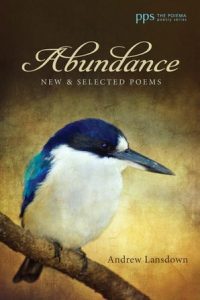
Review of Andrew’s book Abundance in Westerly

Review by Francesca Stewart

Lansdown, Andrew. Abundance: new & selected poems. Cascade Books, 2020. RRP: $29.95, 225pp, ISBN: 9781725284593.

She has learned at last to strike
the red end on the rough edge.
But they still break mid-stroke
or burn her fingers when they burst
to flame.

So opens ‘Lighting a Match’ (42); a momentary glimpse of childhood’s natural instinct in Andrew Lansdown’s Abundance—an anthology of the poet’s finest and best loved works, spanning a thirty-year writing career. The author of fifteen poetry collections, two short story collections and three novels, Lansdown is one of Australia’s award-winning writers. His works both celebrate and unflinchingly engage with life’s most moving experiences.

Abundance offers a rich and varied view of the world through Lansdown’s eyes. By noticing the miraculous and the mundane, and with an ever-present awareness of the passing of time, these poems pay attention to ordinary life and bring a captivating intensity of presence and emotion. Lansdown’s experience of fatherhood is thematic throughout: he looks upon his children with compassion, tenderness and wonder. Simultaneously, by turning the poetic gaze upon himself, he also displays acute self-awareness and disarming vulnerability in observing his mind, emotions and reactions to life.

Lansdown’s poems are rooted in Western Australia, and in them is an immersion in natural and social surroundings, experienced through relatable family moments, such as crabbing and prawning. Kangaroos abound, as do snakes, birds and trees, settling the reader in time and place. Bejewelled with these emblems of nature, Lansdown’s poems contain vivid imagery, cast through sensory detail, creating familiar and inviting scenes. The opening poem, ‘Counterpoise’ (2), sets the tone of the collection:

Light refracting on the reach of the river;
gulls and sails embracing the slight wind;
jellyfish clasping the calm water
or bunting the sand in the basking shallows;
posts of wood barnacled and rotten;
small waves lisping upon the shore;
here is an abundance I had forgotten.

Here Lansdown finds abundance in simplicity and reverence in stillness—the ordinariness of a family day out, made spectacular by the noticing of light and movement and a practice of observance and gratitude. Yet, as much as they celebrate the plenitude of the natural world and the warmth and affection of family, these poems do not overlook life’s challenges. ‘Counterpoise’, also the name of the collection’s opening section, features works on memory, impermanence, fear and grief; most poignantly, the passing of loved ones, including Lansdown’s brother Philip. The event is revisited throughout as Lansdown explores both the impact of it on himself, and as viewed through the eyes of his children.

‘The Horseshoe Shooter’ (26), from ‘Waking and Always’, describes Lansdown’s children’s comprehension of death with dual themes of loss and innocence, and articulates the sometimes stunning ability of children to illuminate the realities of life we attempt to escape. In ‘Spring Morning with Baby and Birds’ (41), Lansdown continues to wrestle with opposing emotions as he comes to terms with new life and devastating loss. Remindful of the deeply complex emotional world of new motherhood in post-partum depression, Lansdown beautifully illustrates the crushing weight of grief against the feathery lightness of hope—that is, the innocence of a newborn juxtaposed with the tumultuous world of adults:

Her eyes hurt me—so bright with hope. I look away.
There is a dove in her throat. It becomes my heart
a bird in a wicker basket. What is this wickedness,
this ingratitude? I place a finger in her palm.

These kinds of poems allow a subtle sense of melancholy to pervade through the collection. Another version of melancholy manifests in ‘The Colour of Life’ (138), which describes the surprising darkness of an ordinary day. The influence of depression is fully acknowledged in ‘Black Dog Snarling’ and ‘Black Dog Dozing’ (165). The darkness of these poems seems to arise from a struggle with impermanence, illustrated in the tense awareness of the passing of time, particularly in ‘Birthday’ (66):

It is my birthday
and my daughter, who doesn’t
suspect the sadness
of a spent year, comes prancing
before her mother.

Yet, through the pages, grief gives way to gentle acceptance and, as though with an audible sigh, later poems tend more towards haiku. Placed at Japanese temples and springs, the haiku deliver a sudden presence and calm contemplation through careful attention to subtle details in the natural world, balancing the sometimes deep and challenging territory the poet treads.

Lansdown’s nature poems prominently feature birds: hawk, robin, kingfisher, heron, ibis, mopoke, wagtail and blue wren decorate the pages with sudden plumes of colour and draw the gaze upwards, lightening and expanding. In this way, the perspective of Abundance is broadened beyond Australia and beyond very personal experience.

Also countering despair is the jubilant joy of intimate relationships. On marriage, love and desire, poems about and addressed to Lansdown’s wife are woven with intimacy and gratitude, as in ‘Opulence’ (86)—an ode to the miracle of life and the bounty of new motherhood:

Her milk has come in
but our son still sleeps.

I cup my palm. Oh,
Such hard opulence!

She lies awake, willing
his hot mouth to squall.

My heart aches with love
As a breast with milk.

Though named Abundance, perhaps what this collection does best is to observe the paradoxes of human life: the nature of parenthood, where the presence of new life somehow draws closer the reality of eventual death; the vibrancy of the immediate moment making impermanence an inescapable fact. An abundance of sentiment, an overflowing of emotion—so much in this life to do, see and feel, almost more than our fragile forms can contain.

This anthology offers a perceptive portrayal of life and its poignant moments, explored as a brother, a son, a father, a husband and a child of the universe. At once an exultation of joy, hope and love, and an acknowledgment of grief, loss and change, through soaring highs and sweeping lows Abundance makes a comforting companion on the days in which we grapple with the big questions, and ask ourselves, ‘What is it to be alive? To be human? To love and be loved?’


Francesca Stewart is the Administrative Editor of Westerly. She is a West Australian writer with an interest in the relationship between the cosmic, landscape and human experience. In her work she explores time and the timeless, beauty, nature and emotion. Her poetry and critical reviews have been published in Pelican, Creatrix and Westerly.

Copyright © Francesca Stewart
Westerly Magazine, March 2023
https://westerlymag.com.au/abundance/
Three Poems in Studio

Three of Andrew’s poems have been published in Studio, Number 153, 2021. The poems are “A Game of Anything”, “Restraint” and “Bamboo Triptych”. The same issue of Studio contained a review by Ian Keast of Andrew’s latest poetry collection, Abundance: New & Selected Poems. (Read the review here.)

Andrew to read at Perth Poetry Club on 1st September

Perth Poetry Club has invited Andrew to read on Saturday, 1st of September.

Andrew will give two readings: One will feature poetry from his latest book, Abundance: New and Selected Poems; the other will feature the poems of William Hart-Smith.

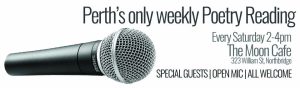
Perth Poetry Club meets every Saturday at 2.00-4.00 pm at the Moon Café, 325 Williams Street, Northbridge.

If unable to attend Andrew’s reading in person at the Moon Café, you can watch via Zoom. Learn how to connect to the Zoom meeting from the club’s website here.


Review of Andrew’s book Abundance in Christianity & Literature

Christianity & Literature, a quarterly journal published by Johns Hopkins University Press (USA) for The Conferenceon Christianity & Literature, has published a review of Andrew’s latest poetry collection, Abundance: New and Selected Poems (Wipf & Stock/Cascade Books, USA, 2021). Written by T. M. Moore (writer, theologian and Principal of The Fellowship of Ailbe – https://www.ailbe.org/), the review is detailed and positive, and is reproduced on this website by permission of the author.


REVIEW by T. M. MOORE

Abundance: New and Selected Poems. By Andrew Lansdown. Eugene: Cascade Books, 2020. ISBN 978-1-7252-8457-9. Pp. xvi+225.

I was not familiar with Andrew Lansdown prior to reading this book, but I found his poems to be among the best I have read in many years. His mastery of form, variety of subject, precision of image, insight to everyday things, and buoyancy of hope and faith make reading his poems a delightful, satisfying, and enriching experience. Besides a few new pieces, the poems in Abundance are taken from eleven previous volumes of poetry, dating from 1980. They demonstrate a consistency of style, craftsmanship, lyric, and beauty that are marks of a very fine poet, one American readers and professors of literature would be pleased to know.

Abundance is a song book of wonder and gratitude. Its overarching theme is captured in the closing lines of “Grace”, from Lansdown’s 1993 collection, Between Glances (73):

“Let us give thanks.” And millions
at mealtime do. Even infants,
those most insouciant of souls,
offer thanksgiving with cries and cooing
as they nuzzle at the breast –
that guzzle-and-come-again fount
where form and feast fuse in bliss
and soft blessing. See how they tug
away from the nipple, smiling.

Eyes closed and heads bowed: it is
the only way to look up. Thank
You. And think of it, the dignity
we gain through humility. Being
grateful. Giving thanks. That precious
repetitious prayer that makes us remember
grace as we say it.

This is followed on the next page (74) by an even more succinct statement of theme, a poem entitled “Abundance”, which enlarges on the title of this collection:

The thing that astonishes me is that
life goes on abundantly without me…

[Here follow four stanzas, in which he celebrates various of the themes that run through his verse. The poem ends,]

Truly, it’s an astonishment,
this abundance independent of me
that touches me seemingly by accident.

Andrew Lansdown’s poems lead us into the mysteries, wonders, and beauty of creation; the joys, sadnesses, and uncertainties of relationships; the essentiality of family and community; the inevitability of death; and the hope of everlasting life in Christ. His work offers a worldview, by which I mean, a way of viewing the world that enables us to see through the everyday, mundane realities of our uncertain and underappreciated existence into the eternal beauty, glory, safety, and joy of our Creator and Lord. In his book, The Divine Conspiracy, the late Dallas Willard wrote, “By showing to others the presence of the kingdom in the concrete details of our shared existence, we impact the lives and hearts of our hearers, not just their heads. And they won’t have to write it down to hold onto it.”[1] This is what Andrew Lansdown does in abundance through his beautiful poems.

Lansdown writes as a formalist poet, though not slavishly so. He employs traditional forms but also fiddles with them a bit, creates new forms, and uses free verse as he pleases. He has also been greatly influenced by Japanese and Chinese poetry, and this volume reflects his love for those themes and forms as well. …

CONTINUE READING T.M. MOORE’S REVIEW HERE

Review of Abundance in Studio

.

Andrew’s latest book, Abundance: New and Selected Poems, was reviewed by Ian Keast in Studio magazine, No. 153, 2021. The review begins:

It was 1980. I was in Sydney for a Conference, and browsing in one of my favourite bookshops which carried a substantial collection of poetry. “You must read this. He’s one of your believing lot. It’s a fantastic collection.” The bookshop owner handed me, Counterpoise, by Andrew Lansdown, just published. From conversations over several years, I knew he held views that were somewhere ‘to the left of Lenin’, so his opinion of Lansdown’s book was a real and very generous endorsement. “Read the title poem. That last stanza is such a marvellous statement.”

The title poem of his first major volume of poetry, Counterpoise, (and the first selection in Abundance), provides a good introduction to Lansdown’s work. The poem speaks of light on rivers, jellyfish, children, grandparents, prawning. Simple ordinary things that point to the certainties and strengths in life. The poem concludes,

How ignorant I have been
through these last years of learning,
how weighted down on one side of the scale.
The large, deep things are all
in their own ways dark and hard.
Small things are a counterpoise
to lighten and soften the heart.

‘Counterpoise’—balancing two different realities—is central to Lansdown’s poetry, both in its style and content. He has a simple, ordinary observation, which—in counterpoise—often produces deep insight. His language is clear and precise, in Les Murray’s words, “he is an imagist of almost unlimited inventiveness”. Once evoked, the reader’s imagination and thinking, can—in counterpoise—be extended beyond the poem to explore further the associations raised. It is this counterpoise of being accessible and profound, which provides the essence of Lansdown’s poetry. …

To read the rest of Ian Keast’s review, go to the Reviews page on this website.

To read publication details of Abundance and sample poems, go the Poetry pages on this website here.

Abundance can be purchased with PayPal on the Buy Books page on this website.

Review of Abundance: New and Selected Poems


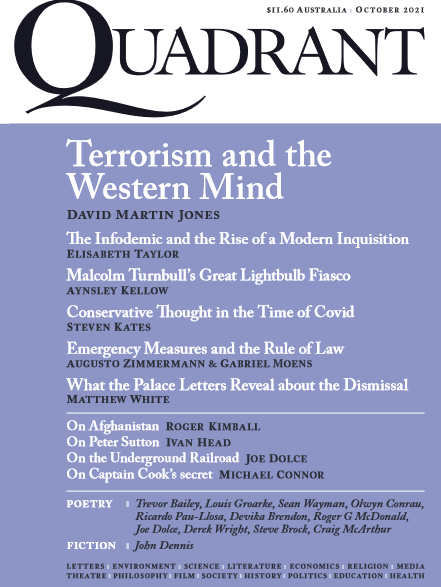
The October 2021 issue of Quadrant magazine contains a review of Andrew’s latest book, Abundance: New and Selected Poems (Cascade Books, USA).

Under the heading “Searching the Poetic”, Ivan Head reviews four collections of poetry, Abundance being the second in the set. His generous and erudite review begins:


Metre and notes also need not be far away when turning to Andrew Lansdown’s wonderful book Abundance: New and Selected Poems. Not that the pursuit of either need detract from the splendid accessibility of this large and carefully chosen collection. For instance, “On Poetry”, the second poem, and reprinted from Counterpoise (1980), carries a dedication to William Hart-Smith, who had a significant influence on West Australian poets. Immediately, one can use the marvels of the net to track material on Hart-Smith and the interaction between these two and other poets before returning to the poetry itself. At the end of “On Poetry”, Lansdown writes of his infant son, not yet walking but sitting on his knee as he talks with Hart-Smith:

my son …

spasmodically stops
our talking with

a short sigh,
and lifts and drops

his foot rhythmically
on the flat of my thigh.

Lansdown is a poet of the embodied and deeply-observed world and, in the end, metre and rhythm in poetry will have more than a close relationship to the beating heart, the dancing feet and all human movement. It is a kind of incarnationalism. Auden’s persona in “The Shield of Achilles” was also looking for figures dancing. To read Lansdown’s new book is to become open to a much wider world.

One earlier publication, Abiding Things, is not represented in this volume. I note that critics of that book said significant things about Lansdown. Les Murray wrote in the Sydney Morning Herald: “He espouses … an aesthetic of small observations”. Rod Moran in the Fremantle Arts Review wrote of Lansdown “lifting the veil of familiarity from the world”, and Philip Salom in the West Australian called him “an imagist of the highest order”.

Micro-observation can go hand-in-glove with a larger metaphysic, even an off-stage metaphysic that is made by the poet’s mastery of the art to serve the poetry, and where the poetry is not a convenient footstool for other concerns that in the end dominate. In that sense of micro, there is something dense and condensed in Lansdown’s poems, a vision lurking. I’m happy to call Lansdown a metaphysical poet. Blake could write in an observational-micro that evoked London in detail, though perhaps his larger vision became obscure in the longer poems. They became seriously esoteric, seriously gnostic. …

Read the rest of Ivan Head’s review of Abundance here.

Abundance shortlisted for Australian Christian Book of the Year

Andrew’s latest poetry collection, Abundance: New and Selected Poems, published in the USA by Cascade Books, an imprint of Wipf and Stock Publishers, has been shortlisted for the 2021 Australian Christian Book of the Year Award. The Award is organised by The Society for Promoting Christian Knowledge Australia Incorporated (SparkLit), and further details can be learned from the official website, SparkLit – Igniting Christian Writing.

The winner will be announced on 2 September 2021.

You can read several sample poems from Abundance here. Go here to purchase a copy.

New Book with US Publisher


A new collection of Andrew’s poems has just been published in the United States by Cascade Books, an imprint of Wipf and Stock Publishers.

Titled Abundance: New and Selected Poems, the book contains poems from eleven of Andrew’s other books as well as some previously uncollected poems.

Read the back cover blurb and some sample poems from Abundance here.

Purchase copies of Abundance (paperback – $29.95; hardback – $49.95; post free in Australia) here.


Andrew’s poem on Kingdom Poets website

Canadian poet and editor, D.S. Martin, posted one of Andrew’s poems, “The Martyred Mother”, on his Kingdom Poets website on 11 January 2021. The post also includes biographical information about Andrew, and alerts readers to the publication of his new book, Abundance: New and Selected Poems, a book that D.S. Martin helped to edit for US publishers, Wipf and Stock. View the post at Kingdom Poets (a blog by D.S. Martin): Andrew Lansdown*.

Kingdom poets featured another post about Andrew, including 3 of his poems, on 2 May 2011 – here, Kingdom Poets (a blog by D.S. Martin): Andrew Lansdown.

D.S. Martin posts a poem every Monday: “Since February of 2010, Kingdom Poets has grown to become an extensive archive — from across the centuries, around the world, and varying church backgrounds.” It is well worth a visit.