

Nicholas Hasluck launched Andrew’s latest collection of poetry, Filling the Emptiness, at the State Reference Library in Perth on Sunday 9 February 2025. Nicholas’ speech was published in the May 2025 issue of Quadrant magazine, and is reproduced in this post.
Fresh Light on the Everyday
by Nicholas Hasluck
Nicholas Hasluck launched Filling the Emptiness (WA Poets Publishing, Perth, 2025, $25), at the State Library of Western Australia on February 9.
We are here to celebrate the launch of Andrew Lansdown’s latest book of poetry, Filling the Emptiness, from WA Poets Publishing. I have known Andrew as a friend and fellow poet for many years. I am therefore pleased indeed to have been offered the opportunity to launch the book and to say a few words about his work.
The title Filling the Emptiness is intriguing, because Andrew has been so prolific since his first book was published in the 1970s that it might seem to a newcomer to the poetry scene that the emptiness, if any, had been filled already. His book Abundance: New and Selected Poems lists fourteen previous poetry titles plus various works of fiction and non-fiction. But one must never think in numerical terms when approaching the work of a dedicated poet. Like most poets, Andrew is constantly striving to see familiar things in a new light or to reveal connections that aren’t usually perceived. From which it follows that a poet’s cornucopia is constantly changing shape and can never be entirely filled.
This emerges early on in Andrew’s title poem, “Filling the Emptiness”, in which the structure of a bamboo, the external beauty of it, the presence of its inner nodes or compartments, is used to suggest the ever-plentiful nature of the stories, real or imagined, that lie within. His poem, in the Japanese five-line tanka form, is presented to us in short sections, each of which, in a suggestive tone, points to hidden layers of meaning.
……….i
Even a bamboo
can only take emptiness
in little doses …
In the stem the nodes divide
the void into compartments.……….ii
A white wafer
hidden in the dark hollow
of the bamboo—
a summons to communion
with the one who put it there.……….iii
Empty lockets
are locked in the bamboo stem
at every node—
saw them free and fill them up
with portraits of ones you love.
I will have more to say in a moment about Andrew’s use of the cryptic Japanese tanka and haiku forms, which he uses to great advantage throughout the book as a means of picturing familiar things in a new way.
Before I do so, let me remind you, as I remind myself, that in a first encounter with a friend’s book one is often drawn immediately to poems touching on shared experiences. Music, for example. Taylor Swift and Beyonce may be names to conjure with in the music world these days but, sotto voce, I have to confess that personally I’m an unreconstructed jazz buff. I treasure vivid memories of visiting Preservation Hall in New Orleans and other iconic venues in Crescent City.
I was therefore drawn immediately to Andrew’s comical poem “Them Shoes” in which he describes raucous party-time revellers in Bourbon Street, New Orleans, beset by trumpet, trombone and tuba, boys tap-dancing for tips, until he is suddenly accosted by yet another denizen of the old French Quarter, a grifter with an alligator grin who points to Andrew’s unremarkable walkers and says: “Where’d you get them shoes?” The poem continues in this way:
Having hooked me, he reels me in with his spiel:
“I could tell you where you got them shoes.”It’s a lurk, a rort, a trick, but how does it work?
I think of a shoe shop in my far-off homeland.“Yeah?” I say, knowing he can’t possibly know,
yet knowing, too, he impossibly does. “Where?”“First,” he says, “you gotta pay for a shine
if I can tell you where you got them shoes.”“Ten bucks,” he says, when I ask how much.
I agree and ask, grinning, “Tell me where, then?”He pulls a rag from his pants back pocket
and drops to one knee on the pavement.Straight-off straight-faced he says: “You got them shoes
on your feet, and your feets on Bourbon Street.”As he lifts my shod foot onto his knee,
laughter and one-leggedness unsteady me.Then to the rhythm of his buffing,
in a mix of southern drawl and black jive,he jibes, “You ain’t payin’ for the shine,
You is payin’ for the education.”Even the price of the Louisiana Purchase
wouldn’t suffice to pay for my elation!
READ THE REST OF NICHOLAS HASLUCK’S SPEECH HERE.

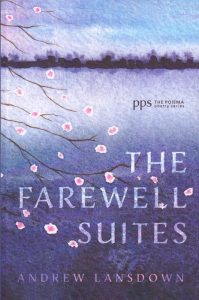 Quadrant magazine has published a review of Andrew’s book, The Farewell Suites., which was published in the United States by Wipf & Stock in 2024. Written by academic and editor Jill Ireland and titled “Durable Hope”, the review appears in the March 2025 issue of Quadrant. It opens:
 Andrew’s shortlisted book, Abundance: New and Selected Poems, did not win the 2021 Australian Christian Book of the Year Award. What were the judges thinking!
 Life Ministries has published a chapbook of Andrew’s children’s poetry—

 Sunline Press has published a new collection of Andrew’s poems titled Distillations of Different Lands.