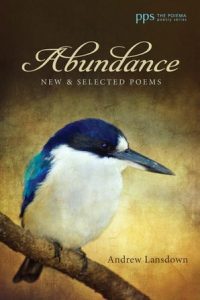
 Review by Francesca Stewart
Lansdown, Andrew. Abundance: new & selected poems. Cascade Books, 2020. RRP: $29.95, 225pp, ISBN: 9781725284593.
She has learned at last to strike
the red end on the rough edge.
But they still break mid-stroke
or burn her fingers when they burst
to flame.
So opens ‘Lighting a Match’ (42); a momentary glimpse of childhood’s natural instinct in Andrew Lansdown’s Abundance—an anthology of the poet’s finest and best loved works, spanning a thirty-year writing career. The author of fifteen poetry collections, two short story collections and three novels, Lansdown is one of Australia’s award-winning writers. His works both celebrate and unflinchingly engage with life’s most moving experiences.
Abundance offers a rich and varied view of the world through Lansdown’s eyes. By noticing the miraculous and the mundane, and with an ever-present awareness of the passing of time, these poems pay attention to ordinary life and bring a captivating intensity of presence and emotion. Lansdown’s experience of fatherhood is thematic throughout: he looks upon his children with compassion, tenderness and wonder. Simultaneously, by turning the poetic gaze upon himself, he also displays acute self-awareness and disarming vulnerability in observing his mind, emotions and reactions to life.
Lansdown’s poems are rooted in Western Australia, and in them is an immersion in natural and social surroundings, experienced through relatable family moments, such as crabbing and prawning. Kangaroos abound, as do snakes, birds and trees, settling the reader in time and place. Bejewelled with these emblems of nature, Lansdown’s poems contain vivid imagery, cast through sensory detail, creating familiar and inviting scenes. The opening poem, ‘Counterpoise’ (2), sets the tone of the collection:
Light refracting on the reach of the river;
gulls and sails embracing the slight wind;
jellyfish clasping the calm water
or bunting the sand in the basking shallows;
posts of wood barnacled and rotten;
small waves lisping upon the shore;
here is an abundance I had forgotten.
Here Lansdown finds abundance in simplicity and reverence in stillness—the ordinariness of a family day out, made spectacular by the noticing of light and movement and a practice of observance and gratitude. Yet, as much as they celebrate the plenitude of the natural world and the warmth and affection of family, these poems do not overlook life’s challenges. ‘Counterpoise’, also the name of the collection’s opening section, features works on memory, impermanence, fear and grief; most poignantly, the passing of loved ones, including Lansdown’s brother Philip. The event is revisited throughout as Lansdown explores both the impact of it on himself, and as viewed through the eyes of his children.
‘The Horseshoe Shooter’ (26), from ‘Waking and Always’, describes Lansdown’s children’s comprehension of death with dual themes of loss and innocence, and articulates the sometimes stunning ability of children to illuminate the realities of life we attempt to escape. In ‘Spring Morning with Baby and Birds’ (41), Lansdown continues to wrestle with opposing emotions as he comes to terms with new life and devastating loss. Remindful of the deeply complex emotional world of new motherhood in post-partum depression, Lansdown beautifully illustrates the crushing weight of grief against the feathery lightness of hope—that is, the innocence of a newborn juxtaposed with the tumultuous world of adults:
Her eyes hurt me—so bright with hope. I look away.
There is a dove in her throat. It becomes my heart
a bird in a wicker basket. What is this wickedness,
this ingratitude? I place a finger in her palm.
These kinds of poems allow a subtle sense of melancholy to pervade through the collection. Another version of melancholy manifests in ‘The Colour of Life’ (138), which describes the surprising darkness of an ordinary day. The influence of depression is fully acknowledged in ‘Black Dog Snarling’ and ‘Black Dog Dozing’ (165). The darkness of these poems seems to arise from a struggle with impermanence, illustrated in the tense awareness of the passing of time, particularly in ‘Birthday’ (66):
It is my birthday
and my daughter, who doesn’t
suspect the sadness
of a spent year, comes prancing
before her mother.
Yet, through the pages, grief gives way to gentle acceptance and, as though with an audible sigh, later poems tend more towards haiku. Placed at Japanese temples and springs, the haiku deliver a sudden presence and calm contemplation through careful attention to subtle details in the natural world, balancing the sometimes deep and challenging territory the poet treads.
Lansdown’s nature poems prominently feature birds: hawk, robin, kingfisher, heron, ibis, mopoke, wagtail and blue wren decorate the pages with sudden plumes of colour and draw the gaze upwards, lightening and expanding. In this way, the perspective of Abundance is broadened beyond Australia and beyond very personal experience.
Also countering despair is the jubilant joy of intimate relationships. On marriage, love and desire, poems about and addressed to Lansdown’s wife are woven with intimacy and gratitude, as in ‘Opulence’ (86)—an ode to the miracle of life and the bounty of new motherhood:
Her milk has come in
but our son still sleeps.
I cup my palm. Oh,
Such hard opulence!
She lies awake, willing
his hot mouth to squall.
My heart aches with love
As a breast with milk.
Though named Abundance, perhaps what this collection does best is to observe the paradoxes of human life: the nature of parenthood, where the presence of new life somehow draws closer the reality of eventual death; the vibrancy of the immediate moment making impermanence an inescapable fact. An abundance of sentiment, an overflowing of emotion—so much in this life to do, see and feel, almost more than our fragile forms can contain.
This anthology offers a perceptive portrayal of life and its poignant moments, explored as a brother, a son, a father, a husband and a child of the universe. At once an exultation of joy, hope and love, and an acknowledgment of grief, loss and change, through soaring highs and sweeping lows Abundance makes a comforting companion on the days in which we grapple with the big questions, and ask ourselves, ‘What is it to be alive? To be human? To love and be loved?’
Francesca Stewart is the Administrative Editor of Westerly. She is a West Australian writer with an interest in the relationship between the cosmic, landscape and human experience. In her work she explores time and the timeless, beauty, nature and emotion. Her poetry and critical reviews have been published in Pelican, Creatrix and Westerly.
Copyright © Francesca Stewart
Westerly Magazine, March 2023
https://westerlymag.com.au/abundance/


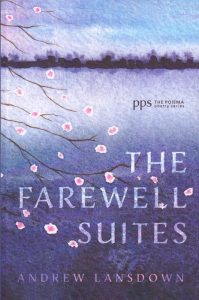 Cascade Books, in imprint of Wipf and Stock Publishers in Oregon in the United States of America, has published a collection of Andrew’s poems titled The Farewell Suites. It is the second poetry collection Andrew has had published in Cascade Books’ Poiema Poetry Series, the first being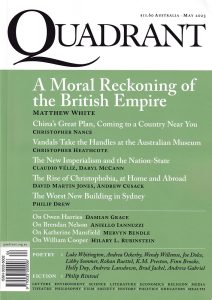

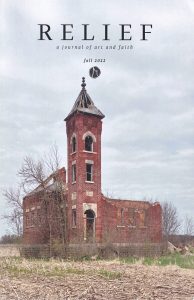 The United States magazine, Relief: a journal of arts and faith, has published Andrew’s poem, “The Remarkable Maples, Kyoto”, a set of ten tanka.