Andrew’s poem “Black Chook” has been published in Oxford English 2: Curriculum Knowledge and Skills. This book by educationalist Paul Grover, is the first in a blended print and digital series written for the Australian Curriculum: English. It is published by Oxford University Press (South Melbourne, 2013). “Black Chook” is republished from Andrew’s collection of children’s poetry, Allsorts: poetry tricks and treats.
Poem in Oxford English 1
Andrew’s poem “In Her Haste” has been published in Oxford English 1: Curriculum Knowledge and Skills. This book by educationalist Paul Grover, is the first in a blended print and digital series written for the Australian Curriculum: English. It is published by Oxford University Press (South Melbourne, 2013). “In Her Haste” is republished from Andrew’s books, The Grasshopper Heart (1991) and Gestures of Love (2013)
Poem in Westerly

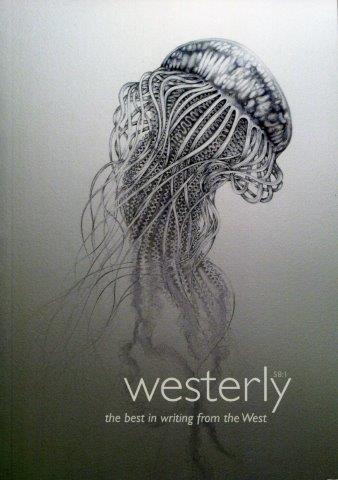
Westerly magazine has published Andrew’s poem, “Travelling North”, in its June 2013 issue. The poem is reproduced below. (Details of the June 2013 issue of Westerly can be found here: http://westerlymag.com.au/issue/58-1/.)
Travelling North
The Canada geese go over,
fly over in a skein,
high up and (I imagine)
honking beyond hearing.
And I suddenly wonder,
What am I doing here
in America travelling north
deeper into Wisconsin
where the first snows
have already fallen,
travelling north when
even the geese know
the killing cold is coming
and south is the place to go?
© Andrew Lansdown
Four poems in Quadrant
Four of Andrew’s poems were published in the July-August 2013 issue of Quadrant. One of the poems, “Five Flowers”, consists of five tanka – (1) “Composition”, (2) “Plenty”, (3) “Celebration”, (4) “Wheel” and (5) “Drive”. Another of the poems, “The Darkness Tanka”, consists of three tanka – (1) “This Morning”, (2) “At Nightfall” and (3) “Tonight”. The other two poems are “Artistic Licence” (a choka) and “Correspondence” (a tanka). All these poems will appear in Andrew’s new book, Inadvertent Things: poems in traditional Japanese forms, which will be released by Walleah Press later this year.
Andrew’s poem set to music by Joe Dolce
Singer-songwriter Joe Dolce has put Andrew’s poem “Samurai” to music. Joe has posted a demo of the song on Soundcloud, here http://soundcloud.com/joe-dolce/samurai.
Joe states that it is “still only the original demo but it will have to do until I get back in a real studio again.”
The photograph of Andrew (above) is one that Joe collaged to go with “Samurai” for Soundcloud.
Two poems in Quadrant

Two of Andrew’s poems were published in the May 2013 issue of Quadrant. The poems are: “Us2” and “Mali Blues Guitarist”. You can read “Us2” on the Quadrant website here: http://www.quadrant.org.au/magazine/issue/2013/5/us2
New poetry collection
Wombat Books/Even Before Publishing has published a new collection of Andrew’s poems, Gestures of Love: The Fatherhood Poems.
As the subtitle indicates, the collection is a thematic one, with all the poems focused on family and fatherhood.
While some of the poems are new (uncollected), most have been taken been selected from Andrew’s other poetry collections.
As stated on the back cover blurb:
.
Few poets have explored the weight and wonder of fatherhood like Andrew Lansdown.
Over the years he has established a high reputation for his subtle, insightful poems about his wife and children.
Acclaimed poet and critic Geoff Page has observed that “Lansdown has a very sincere and direct way of handling poems about his immediate family which subtly suggests great tenderness without becoming sentimental.” And world-renowned poet Les Murray has claimed that “no one writes of family love with more tenderness than he.”
Now, for the first time, Andrew’s widely-published, award-wining poems celebrating family life are gathered in one collection, Gestures of Love. These fatherhood poems are bound to delight and move all readers—not only parents, but also anyone interested in the joy, grief and quirkiness of the human condition.
Gestures of Love (pp. 136) is priced at $15.00 and can be bought through this website or from Wombat Books or ordered through you local bookshop.

Poems in The Canberra Times
The Canberra Times has published Andrew’s poem, “Music Tanka”. The poem, which appears in the 2 March 2013 edition of the newspaper’s Panorama magazine, consists of two tanka, as follows:
Music Tanka
1. Seeing the Sound
As to the eye
the springing of the mallets
so to the ear
the bounding of the poundings
from the taut timpani skins.
2. Purity
The notes are flat
and the timing is out, yet
what pure music
they make, the little sawn lengths
of bamboo bumped by breezes.
© Andrew Lansdown
These two tanka are included in Andrew’s forthcoming book, Inadvertent Things: poems in traditional Japanese forms, scheduled for publication later this year by Walleah Press.
Poem in anthology None So Raw As This Our Land
Andrew’s poetry is represented in a new anthology, None So Raw As This Our Land, published jointly by the Association of Stories in Macao (ASM), Cerberus Press and the Westerly Centre at the University of Western Australia. The anthology contains the original English texts of poems by 17 Western Australian poets along with translations of those texts into Chinese. The editor is Christopher (Kit) Kelen, while the translators are Iris Fan Xing, You Chengcheng and Song Zijiang.
Professor Delys Bird of the Westerly Centre, UWA, writes on the back cover blurb:
This unique anthology is the product of an equally unique project, involving Chinese translators from the University of Macau, and members of the project’s host, the Westerly Centre at The University of Western Australia. Intense discussion between poets and translators enriched the sometimes barren work of translation, resulting in a truly cooperative work, bringing together the poetry of seventeen West Australian writers. Their work demonstrates the strength and breadth of Western Australia’s writing culture as well as the impressive range of their voices. The anthology is significant as it makes that poetry available to a culture with the largest number of language speakers in the world. Yet this book delivers something even more important, creating connections between cultures through poetry and rendering effective and affective, those imaginative meetings.
Andrew’s poem in the anthology, “Finishing Up”, is translated by You Chengcheng. Both the poem and the Chinese translation are included below.
Poem in anthology Notes for the Translators
Andrew’s poem “Finishing Up” has been published in an anthology edited by Christopher (Kit) Kelen for the Association of Stories in Macao (ASM) and Cerberus Press. Titled Notes for the Translators, the book contains poems from 142 Australian and New Zealand poets. Each poem is accompanied by a brief commentary by it author. The back cover blurb explains:
Notes for the Translators introduces the poet-translator to the work of 142 contemporary New Zealand and Australian poets. It is a pedagogic work, for use inside and outside of the classroom. Its aim is to help train poets as translators, and to train translators to be poets.
This is a practical book—a book with a simple facilitative aim. From the poems presented in these pages, and from the accompanying notes provided by their authors, translators will be able to offer a collection of contemporary Australian and New Zealand poetry to readers of languages other than English. With a few exceptions, each poem in the book is short (forty lines or less), the accompanying notes only a page or two of reading; therefore it should be possible to make a first draft translation for each poem in a single sitting. And so—from the materials offered here in this book-for-the-making-of-books—it should be convenient to commence the step-by-step building of a foreign language anthology.
This is a maker’s, not a critic’s, book. The notes are there to help the reader/translator understand a poet. The notes are from one poet to another; they are a helping hand across the cultural/linguistic gulf. If they are, needs be, written to some extent blindly (that is to say, without full knowledge of what lies across the gulf), then that will be a part of their beauty, of their poetic quality, and it will be a measure of the trust we place in strangers when we dedicate our hearts to the project of reaching a reader.