
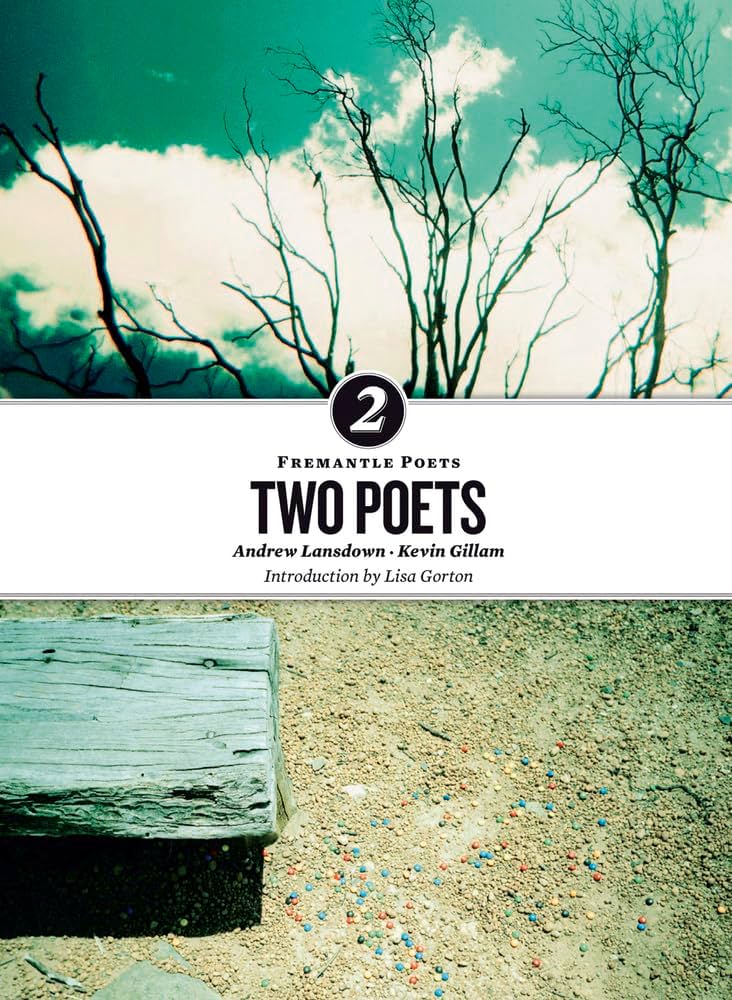
Two Poets
ISBN 9781921696602
Two Poets contains two collections of poetry:
The Colour of Life by Andrew Lansdown
and Songs Sul G by Kevin Gillam
Two poems from Andrew’s collection in Two Poets
Opening poem:
Finishing Up
Nightfall … and I am still here
in the school at the prison farm.
My children will be at the table, filling
their mouths with food and chatter.
And the littlest one will be asking
her mother, “Where is Daddy?”
I am where my resignation
has led me. My roguish students
are in the compound, locked up
for the night. Except for the sentries
the guards are gone. I am alone,
finishing up. Did I miss someone
when I said goodbye? Does it matter?
We have been good to one another,
these bad men and I. I try not
to think I will never see them again.
I am alone. I look out the window.
The forest is in silhouette.
On the lawn, almost dissolved
in the dusk, a young kangaroo
hunches on its haunches to graze.
It was not there a moment ago and
in a moment when I open the door
it will not be there again.
© Andrew Lansdown
Read Andrew’s “COMMENTS ON THE POEM, ‘FINISHING UP’ ” here – https://andrewlansdown.com/articles/literary-essays/
Title poem:
The Colour of Life
.
Why is it that here in this cafe,
a hard wind harmless on the window,
a bright fire coughing in the grate,
scones and tea on the table, I feel
.
suddenly, strangely sad? Why is it,
and what? A loneliness, a longing—
not, it seems, in spite of, but
because of, the loveliest of things.
.
It is the colour of life. Sabi
the haiku poets would say. I say
too much. I break a scone and steam
wafts from the wound, like
.
the spirit of a just man, going home.
.
© Andrew Lansdown
Introduction to Two Poets
Introduction to Two Poets
by Lisa Gorton
.
Here are two markedly different Western Australian poets. Both pay attention to small facts of nature. Both treat poetry as a work of intimacy, not performance. In tone, both poets are closer to the voice of the diary than of the cafe or pub. Even when they deal, as they often do, with suburban domestic life, their poems mark out a place of inwardness. Yet their collections reflect and create different imaginative worlds. In particular, these two poets relate differently to time: Lansdown’s poems work to distil and preserve a single moment, whereas Gillam’s work to capture the moment-by-moment experience of time. Intriguingly, their writing habits reflect this difference. Lansdown works in a study, seated at a window, looking out. Gillam gets ideas for poems walking the back lanes around where he lives. This difference could be said to define the nature of each poet’s achievement.
Lansdown engages consistently, though by no means exclusively, with the austere Japanese tradition. Almost all his collections include haiku or tanka sequences: short poems in syllabic verse that capture a single observation in exact and simple words. As one of Lansdown’s poems puts it, ‘Haiku are pebbles/ poets lob into the pond/ of our emotions’. Lansdown brings that understated discipline to his descriptions of the Australian landscape.
The Australian painter Fred Williams once remarked thatAustralia’s landscape has no vanishing point. Working with haiku, Lansdown frees his poems from what you might call the argument of foreground and background. His are small-scale, exact observations. As a consequence, his haiku and short poems about birds and flowers achieve a sense of place remarkably free of the usual rhetoric of landscape. They are one of the best reasons to read this collection.
Over nearly forty years, Lansdown has worked at this art of precision. Most of the poems collected here are new, but there are some from his award-winning 1993 collection, Between Glances, and some from his 2004 collection, Fontanelle. He started some of the poems newly published here more than a decade ago. Nonetheless, this selection has the coherence you might expect of a single collection. Together, these poems show how an aesthetic of exact detail and subtle craft has shaped his poetic idiom – has become the very language of his thought.
Even many of the longer poems work with the kind of precision that haiku requires. Take ‘Fontanelle’, for instance – one of the standout poems in this collection. A poem of seven two-line stanzas, it maintains the lucidity and efficiency of haiku. It starts, ‘Strange, this seeing/ the heart in the head’. In this poem, the first line of each stanza has four syllables, the second, five: a heart-beat rhythm worked not by word-stress patterns, but by line lengths. But Lansdown is typically understated, and combines this clean use of language with a tone of unforced directness.
If you were to express in architecture the various styles of poetry, the place where Lansdown writes could serve as an image of haiku. This dedicated room, with a desk at the window, suggests at once haiku’s containment and its commitment to looking out. It is characteristic of Lansdown’s straightforwardness that a number of poems in this collection make reference to this writing room. He writes in ‘This Abundance’ of ‘Stepping out of my study’. ‘Disturbance’ starts, ‘Again from the corner/ of my writing-room window …’. But perhaps the most memorable of these writing-room poems is ‘The Visitor’:
My landlord’s small, blond-haired boy
comes daily to peer through my windows –
four oblongs of glass forming the corner
of the room against which my writing desk
is nestled. My sunpanels and pleasures.
Lansdown has written three children’s novels and this poem illustrates with what ease he can work with narrative. In this case, the boy’s interruption pushes the poem past its single moment: Lansdown imagines the boy’s view from outside, looking in. This outside view prompts a meditation on the nature of his work: ‘I have come to this room/ wanting not visitors, but visitations.’
There is almost always in Lansdown’s work this sense of the window: clear, polished, made for looking out. Though the celebration of nature might be said to be the defining motive of his work, it is nature in itself he seeks to celebrate – not for him the Romantic tradition of finding the mind in the world. As a consequence, his poems, for all their play of sound, have a quality of stillness: the space of the page around them seems charged with silence. His poems typically capture not the experience of life in time, but the experience of moments outside time – visitations. For this reason, his poems often work with cameras, windows and reflections. His poem ‘Macro Movements’ illustrates his poetic ambition to still the single moment in its fleetingness: ‘On macro setting –/ I’m trying to photograph/ a bee on the buzz … As my camera/ clicks, it flits to my finger –/ the red dragonfly.’ Perhaps his tanka ‘Signal’ is so intriguing because the setting serves as an image of how the poem itself works – with a sense of distance, closed in its small frame:
As I lift the mug,
light reflects from its glazing
in the black window –
faint and intermittent like
a lighthouse signal, far off.
Kevin Gillam has also taken up haiku. Indeed, his poem ‘untitled’ …
.
from the Introduction to Two Poets by Andrew Lansdown and Kevin Gillam (Fremantle Press, 2011)
.
© Lisa Gorton
Interview with Andrew on Two Poets
Interview with Andrew about his collection, The Colour of Life in Two Poets
Naama Amram of Fremantle Press interviews Andrew Lansdown concerning his forthcoming collection, The Colour of Life, in the book Two Poets – June 2011.
Naama Amram: Your collection in this book is called The Colour of Life. Can you tell us about the significance of this title?
Andrew Lansdown: The title has, to my mind, two implications, or applications.
Generally, the colour of life is the range of moods and emotions arising from the range of situations and perceptions depicted in the poems in my collection.
Specifically, the colour of life is the sense of aloneness and longing that surprises us, ambushes us, repeatedly throughout life. It is a form of grief—grief felt, often, without evident cause. It is not a denial of the loveliness and happiness of life, but an underlying sense that something is missing and/or amiss.
Well, so much for attempts at definitions! In the end, the colour of life can only be truly expressed in poetry or prayer. I have attempted to capture and convey it in poems such as ‘Happiness’, ‘Human’, ‘Me’ and ‘The Colour of Life’.
Naama: You often work in the Japanese forms of haiku and tanka. Why?
Andrew: I work in whatever poetic form will yield at the time of working. Often I do not know what form a poem will take when I begin writing it. The appropriate form becomes clear only as the poem progresses.
As evidenced in The Colour of Life, I work in rhyming couplets (eg, ‘Prayer Against Pain’), rhyming quatrains (eg, ‘Train to Wyong’), free verse (eg, ‘The Nemesia’ and ‘Boat’), unique syllabic structures (eg, ‘Menace’, with 8 couplets of 6- and 10-syllable lines, or ‘End of Day’, with 10 tercets of 7-, 5- and 7-syllable lines), sestina (eg, ‘Sestina on a Journey’), choka (eg, ‘Renewal’), and villanelle (eg, ‘Prayer’). However, the forms most represented in The Colour of Life are haiku and tanka.
I have found over the years—and increasingly in recent years—that haiku and tanka often suit my poetic purposes. I love the compactness and balance of both these traditional Japanese forms. And I love the discipline of writing in objective forms that compel and enable me to distil setting/subject/theme/mood in just 17 or 31 syllables.
I have also found it rewarding to group haiku together under a common heading. Such groupings are called ‘gunsaku’. The haiku in a gunsaku have a common setting or subject or theme or mood, and yet they do not build on each other, like the stanzas of an English poem or the interdependent poems in a sequence. The haiku in a gunsaku are autonomous poems, poems in their own right: but gathered together they enrich each other and create an impression that is greater than they would/could achieve individually. (Tanka can also be gathered into gunsaku, although The Colour of Life does not contain any of these.)
Naama: You have been publishing poetry for nearly four decades. What inspired you to write then? Has that changed, and if so, what inspires you today?
Andrew: I was inspired to write at the age of sixteen when I heard a boy my own age read a poem he had written. I was astonished that someone like me could do such a thing and I desired to be able to do it, too.
Also, at the time, I was listening to traditional and contemporary folk music by artists such as James Taylor, Donovan Leitch, Melanie Safka, Leonard Cohen, Bob Dylan and Steeleye Span. This type of music, of course, places great importance on the lyrics. I think this influenced me, too.
What inspires me to write poetry today is the sheer love of poetry. I love reading it. I love writing it. I find it to be the perfect literary form for the expression of grief and joy and every emotion in between.
Naama: What is your writing space like? And how would you describe your writing habits?
Andrew: My writing habits are not as strict as I would like them to be. So many other things in life push in and push poetry out.
I write mostly in my study, at my writing desk, in front of a large window that lets me see a birdbath, arrow bamboo, and an almond tree. Although I try to write every day, I do not always write poetry. Stories, novels and essays also have a claim on me.
Naama: Poet and critic Lisa Gorton notes that both you and Kevin ‘treat poetry as a work of intimacy, not performance.’ In the process of writing this book, have you learned anything from Kevin’s work?
Andrew: Kevin and I were not involved with each other when we wrote our poems and compiled our collections. It was, happily, Fremantle Press’s initiative to place our collections together under the Two Poets cover.
I am very pleased to share a book with Kevin. As readers will discover, Kevin and I write very different sorts of poetry. Yet I think our collections compliment each other precisely because they are so different in style and sentiment.
As for learning from Kevin: I cannot point to anything specific. However, I am convinced that reading good poetry contributes to one’s understanding of poetry, which in turn contributes to one’s ability to write it. On that score, I presume Kevin’s poetry has influence me in subtle, if indefinable, ways.
I think Lisa Gorton is right to say that both Kevin and I ‘treat poetry as a work of intimacy, not performance.’ Implicit in her words are several truths about both of us as poets: we write with sincerity; we do not write to show off; and we write with craftsmanship and rigour.
Naama: What is the greatest challenge that poetry presents to you, and how do you overcome it?
Andrew: My greatest challenge in writing poetry is overcoming the feeling, as I face a blank page, and as I begin to toy with images and ideas, that I can’t possibly write another poem. At the start I feel I can’t do it; and at the end I feel I can’t do it again. I overcome this by persevering with the poem at hand—and by remembering that I have had these feelings many times before and many times before they have proven wrong.
Naama: What writing projects are you currently working on?
Andrew: I am working on another collection of poetry, provisionally titled Gestures of Love. It will consist of poems written solely in the traditional Japanese forms of choka, tank, haiku and gunsaku (haiku or tanka groupings).
Copyright © Andrew Lansdown
An edited version of this interview, combined with an interview with Kevin Gillam, can be read on the Fremantle Press blogspot here
and on the Fremantle Press Facebook site here.
Reviews of Two Poets
Unattributed review by writingWA
Fremantle Poets 2, Two Poets Andrew Lansdown and Kevin Gillam (Fremantle Press, $24.95, 228pp)
Reading Book 2 in the Fremantle Poets Series had me wondering if I were a prospector coming upon not one but two gold nuggets of Australian contemporary poetry. With the younger of the two, Kevin Gillam, I felt I’d struck gold with his inimitable depiction of Australian suburban life, complete with characters, colours, smells and sounds-the background to the lives of most Australians. The sounds and other images have a richness and timbre only equalled on the national poetry scene by his co-author, Andrew Lansdown. We know the latter’s brilliance as a poet of family life and suburban bush creatures. This volume continually rewards with words of pure gold.
Review by writingWA, July 2011
Read the original review at https://www.writingwa.org/booksreviewed/2011-reviews/
Excerpt from “Collections of verse in a human key”
by William Yeoman, The West Australian (”Today” section, page 7), 5 July 2011
Gillam and Lansdown’s collections have been issued together in one book, the second volume in the Fremantle Poets series, Two Poets. Strange bedfellows?
“Kevin’s work is quite different from my own,” Lansdown says. “But that’s one of the strengths of the book: that there are two collections which are very different in their poetic approach.”
Lansdown, a Perth poet who has written 17 books of poetry and fiction, many for children, says he’s “not interested in writing things people can’t possibly understand and then pretend you’re being profound by doing that”.
And yet Lansdown, who says the common integrity underlying all his work arises in part from his Christian faith, is a subtle orchestrator who works within both Japanese and European traditions. “I’ve found Japanese haiku, tanka and choka truly beautiful forms to work within,” he says. “They enable me to explore, capture and convey those very small things which otherwise might be overlooked but which are lovely in themselves.”
Witness his tanka, Overheated: “In the shrinking pool,/a dying marron, its shell/jacked up like the cab/of a semitrailer with/an overheated engine.”
Read the full article here: http://au.news.yahoo.com/thewest/entertainment/a/-/arts/9786754/collections-of-verse-in-a-human-key/
.
.
Review of Two Poets
by Annerliegh Pappos
I love the first half of this book. Lansdown is an interesting poet. Totally unashamed of using the exclamation mark and it works for him mostly. His poems about childbirth and his growing child, and the relationship between this and mental health are sublime. Totally human, never gratuitous.
The poem ‘Heat: After the third day of Desert Storm’ is stark perfection. The images are so vivid whilst using plain language.
Possibly my only criticism is the overly-lamenting style of some pieces. It can be a little on the bush ballad side for me.
The other half by Gillam fails to capture my interest. I could barely find anything to relate to and eventually put the put down permanently. I do recommend others giving it a go however – many of Gillam’s individual lines or verses are interesting – original ideas or takes on experience.
© Annerliegh Pappos
goodreads.com, 7 August 2012
http://www.goodreads.com/review/show/386620319
http://www.goodreads.com/book/show/13016084-two-poets#other_reviews
RETURN TO ANDREW’S POETRY COLLECTIONS