
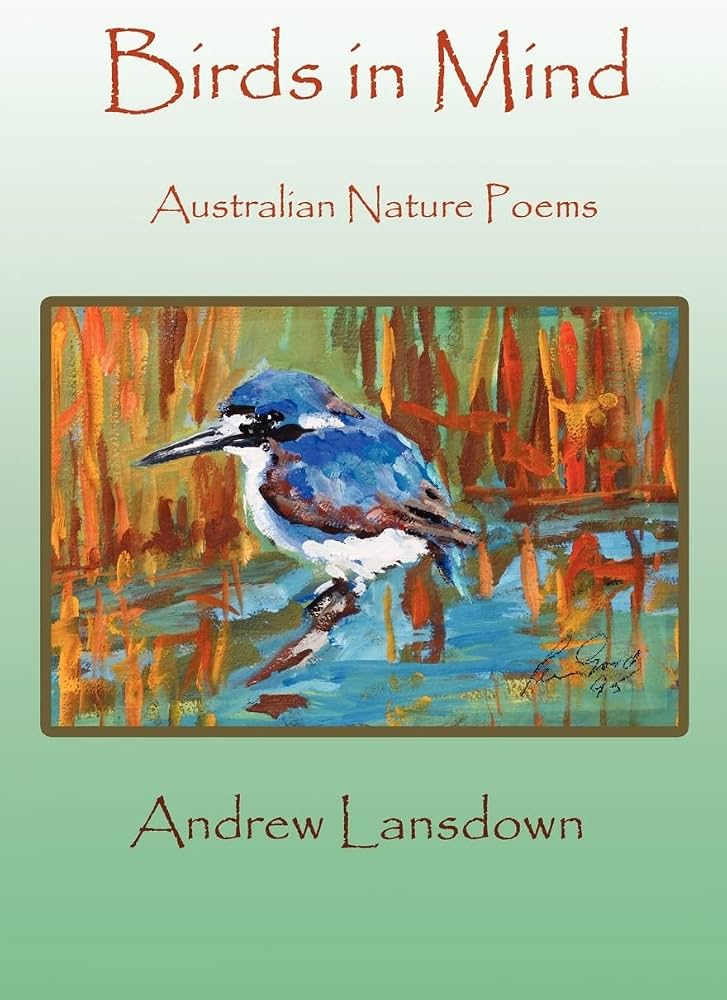
Kingfishers and zebra finches, triggerplants and tiger snakes, sandcrabs and cabbage moths, wattles pods and waterlilies—all find a place in this collection of poems celebrating Australia’s native and exotic flora and fauna.
Birds in Mind brings together over 200 poems by one of Australia’s finest nature poets, poems as varied in style and tone as they are in subject and theme, poems that will turn readers into nature and poetry lovers if they aren’t already!
“Lansdown uses words with masterly precision to paint things as we have not previously seen them, but as we may be tempted to see them henceforth. His approach to his material is confident and systematic. And beguiling …
“Sometimes the images are so acutely accurate they have us asking ‘Why didn’t we see that same similarity, that resonance?’”
Shane McCauley, Fremantle Arts Review
“Lansdown spices the world with pinches of finches.”
Les Murray
Launch speech for Birds in Mind
Eminent Western Australian poet and critic, Shane McCauley, launched Andrew’s latest collection of poetry, Birds in Mind: Australian Nature Poems, on Saturday 24 October 2009. Speaking to a gathering of about seventy people, Shane McCauley said:
I was very touched, and of course honoured, when Andrew Lansdown asked me to launch his wonderful collection of poems, Birds in Mind: Australian Nature Poems. Ours has been a long acquaintance and friendship, going back to the mid-1970s or so. For a while, we were always the youngest WA poets to appear in anthologies such as Quarry, edited by Fay Zwicky in 1981. And I note that several of our near contemporaries in that anthology have gone on to either better or worse things, but Andrew and I have somehow managed to stay in the poetry-writing business.
 Initially, there are several things to note about Birds in Mind. Firstly, the sheer size and scope of the subject matter. The joy in birds is apparent from the title, but they are only some of the creatures and plants the poet celebrates and sometimes mourns. You will also find superbly spare descriptions of, and reactions to, shells, frogs, lizards, kangaroos, crabs, fish, sunflowers, bamboo, orchids, trees in abundance—karri, jarrah, marri, redgum—and much, much more.
Another initial observation concerns the variety of places in which these poems have been published—they have obviously appealed to many different editors, and the Acknowledgements page is really mind-boggling. Apart from appearing in countless Australian journals and anthologies, many have been published overseas, in Japan, the USA, the UK.
A third observation is in regard to the quality of the book’s production itself and the generous 223 pages—no “slim” volume of verse this! The beautiful cover painting is by Andrew’s late friend and mentor, Peter Good.
Andrew’s poetry is much influenced by Japanese short forms such as haiku and tanka that aim to capture the particularity, the is-ness, of (usually) a natural object, animal or scene. The goal is to achieve a rendering of this essence in just a few words. Andrew is adept at both forms (and many traditional Western forms, too) but it is more the spirit, the underlying intention, of them that gives grace and lucidity to all the poems gathered here.
Purely descriptive nature poetry can sometimes pall if it is not accompanied by insights, revelations, new slants. Andrew’s poems abound in these and irresistibly startle and delight, aesthetically appealing both to mind and emotion. Open the book anywhere and you will find descriptions of birds and animals we have all seen, but that are suddenly lifted here into another dimension via a combination of the poet’s imagination, diction and control of form. Here is one of my favourites, “Hawk” (p. 56):
Hunched in an overcoat of feathers
a hawk on the high wire,
like a snapshot of a shrugAs easily as he wields the wind in his wings
and clamps small creatures in his claws,
he sheds the world from his shoulders
We’ve all seen that hunched bird up on the wires on a cold day, but who has so perfectly fixed it in our memory as Andrew?
The poet’s capacity to be continually astonished by the natural world is both very moving and inviting, too. We, the readers, are also encouraged to look with new eyes on things we might have taken for granted. These poems are full of those “Ah!” moments beloved of the haiku poets. Humble slaters, wood lice, “forage about in their armoured coats/ like miniature armadillos”; a jewel beetle basks “in rainbows, like a drop of oil”; the bobtail has “unexpectedly, a yellow flower/blooming in the back of the throat”; straw necked ibises are “like elderly Oriental/ gathered for a festival”. This is poetry forged from a brilliant combination of observation and compassion, what [the Chinese philosopher] Mencius referred to as the “thinking heart” (or maybe camera with heart!).
Although great beauty and a sense of joy infuse these poems, it should not be thought that they are in any way merely “pretty” or dainty. Nothing could be further from the truth, for thought Andrew delights in the natural world, he does not shy away from its less attractive manifestations (though the negative is frequently related to some human intervention, as in “Snake in a Box” or the mindlessly cruelty “Blowfish”). There is grit and blood and pain in this poetry, too: I won’t read “Four Men” to you, a graphically precise account of mulesing, lest anyone here, including myself, passes out. Nature here is multifarious and complex, powerful and sometimes violent, as well as exquisite in its forms, colours and profound variety.
There are some poems, such as “Trap” and “Good Catcher”, wherein Andrew contemplates the innocence of children coming into contact with some of the problems related to human responsibility in the face of nature—that we are here, as I think Rilke puts it, as guardians, protectors not owners of what surrounds us. The poet muses on his child in “Good Catcher”: “He is too young to know/ how some things are crippled by love/ if they’re not let go.”
I could single out countless other poems for their wisdom and whimsy and elegance, but I am aware just how eager you are to buy and read the book yourselves! I would just like to conclude with one small poem, a tanka, that for me best encapsulates the driving force of Andrew’s poetry. It is very appropriately called “Importance” (p. 216):
Given that God
did not consider robins
too small to make,
I regard them big enough
for my poems to celebrate.
Enjoy this major contribution to Australian poetry. I have the greatest pleasure in announcing that Birds in Mind is launched! Thank you.
Shane McCauley
24 October 2009
Photographs (above) by Dwight A. Randall:
1st photograph – Shane McCauley launching Birds in Mind
2nd photograph – Andrew Lansdown reading from Birds in Mind at the launching
Seven poems from Birds in Mind
Birds in Mind
i
Sacred kingfisher—
into the world onto the branch
courtesy the King.
ii
Wren and the art
of bird-making—dear Lord, such
blue in the bush!
iii
Statuesque heron—
unmoved as humans debate
the Sculptor question.
iv
Goodness, that ibis
signals the presence of birds
in the mind of God!
© Andrew Lansdown
Desertion
Where the track curves out of sight
between the fire-scarred jarrahs,
shadowy among the shadows but noisy
for the forest litter, kangaroos
are rising and retreating. An awe,
an ache, this glimpse. Proceeding,
I discover where they dozed beneath
the grasstrees. I feel their desertion.
I wonder if I should go on or go back.
Either way, who will give me welcome?
© Andrew Lansdown
Poem about Freedom
I am sitting in the shade
of the lemon tree, trying to write
a poem about freedom. But
my son is swinging in the almond,
calling, ‘Dad, look at this! Dad!’
The day conspires to distract me
from things I have designated
important. On a branch
arching over me, a lemon’s
green rind is yielding to yellow.
Near my feet, a hornet
is hurtling sand from a hole
set in a clear space
between the rootbound and budless
chrysanthemums. In the apple tree
the fruits’ round cheeks
are powdered with rouge
and a parrot is summoning its mate
to a feast. Now my daughter
crams her rag doll
in the cane chair beside me and
places in its lap a sprig of mint.
Bruised by her clumsy hands
it smells so clean and sweet.
© Andrew Lansdown
Throat Notes
i
Buzz-note beeping—
a juvenile zebra finch
gapes for feeding.
ii
A squawking split-
note from a finch with a fuzz-
box in its throat!
iii
Tibetan monks,
fledgling finch, also utter
a double note!
iv
Are you gagging
or just throat-singing, feeding
fledgling finches?
v
Your throat-singing,
immature finch, is making
your mum throw up!
© Andrew Lansdown
Pink Fan Triggerplants
Who sets the heart for wonder?
What triggers the spring of praise?
Look! In a tumble of pink on the scree,
triggerplants—primed with pollen,
hammers cocked. Like the children,
I kneel to touch the heart of a flower.
© Andrew Lansdown
Pine and Poem
Unlike other trees, the Norfolk Island pine
neither gives up and droops over nor disperses
into branches. No weeping, no compromise.
It surges straight up. Even its laterals
support the single perpendicular.
Each ring of branches is a set of guys
anchored to the sky to keep the centre post
poised. Diminishing in diameter,
the spoked strata shape a tent
as a farthingale shapes a dress.
The green frame, tall, conical, waiting
to be covered. Trim the sky for a canvas.
Peg it down. Don’t let it flap loose
from your imagination. Gales are gathering.
Strong winds are coming. Stake out
your tent. Enter in. Enter in to the calm.
© Andrew Lansdown
Reviews of Birds in Mind
Just released: ‘Birds in Mind’ by Andrew Lansdown
from his blog, hi spirits: http://hispirits.blogspot.com/2009/10/birds-in-mind-by-andrew-lansdown.html
Author Andrew Lansdown is renowned for his award winning poetry. In this brand new collection of over 200 pages there are poems told through various forms, but all with a focus on nature.
On the back, Les Murray says: “Lansdown spices the world with pinches of finches.”
There are many haiku and tanka within these pages, and the same accurate eye and ear is brought to bear in other forms on much minutiae of the natural world.
Here’s a little poem, as many of them are, as a taster:
Street Artist
Using pompom brushes
and a pointillist technique,a wattle tree has dabbed
a park bench with yellow.© Andrew Lansdown
Resonance in the Natural World
by Hal G.P. Colebatch
Birds in Mind
by Andrew Lansdown
Wombat Books, 2009, 224 pages
Andrew Lansdown is one of a very small handful of West Australians who, for more than 30 years, has committed himself steadfastly to writing, with poetry a major part of his output. His many books include the popular series of children’s adventures beginning with With My Knife, and collections of essays. He has recently launched a website and has an impressive collection of literary prizes. He has, from his first work, established a distinctive and individual voice.
Birds in Mind, a very substantial collection of 224 pages, consists mainly of “nature” poems, of birds, fish, flowers and animals, often with a Japanese cast to them. “Lansdown spices the world with pinches of finches,” according to Les Murray. However many of these have deeper resonances behind them, such as the grim “Poised on a Premonition” and the equally grim “Blowfish”:
i
Giggling, a young girl
tickles with the tip of her knife
the blowfish’s belly.
ii
Gulping in the air
that’s killing it, the blowfish
inflates its belly.
iii
‘Let me,’ the boy begs,
raising his boot high above
the blown-up blowfish.
“Spring, Alfred Cove,” shows his mastery of longer lines in the creation of a landscape. It begins:
This wildlife sanctuary: the last wetland on the Swan
River estuary. How long will it last? Some call it
wasteland, and few notice it at all. A patch of sedge
signals in semaphore to an inattentive world.
Samphires mat the mudflats, their bulbous stems
like strings of red and green rosary beads. …
Much of his work contains surprising little “packages” of ideas, in some ways reminiscent of the work of the late Bill Hart-Smith:
A eucalypt bud is an incarceration of strong men—
boxers—cramped, bent double in a green locker-room
with a conical ceiling-cum-roof. Though they dislike
each other, they co-operate, set their shoulders
to the shelter’s cover. They press and push, crack
the seal that holds the ceiling to the circular wall,
then shunt the roof right off. Breaking out, they
cheer in bold colours, brandish their golden gloves.
The poems cover a wide variety of subjects, from the poetically familiar (“Pelicans”) to the strange: he is one of only two poets I know who have written poems about daddy long-legs. There is also the wonderful but ruthless life of the sea’s edge. One of the important themes of this book is gratitude for the richness of nature, as with “Almonds”. Simple objects and images become “blessings.”
First a galah, now
a pair of parrots have come
to the almond tree.
Give them up, the unripe nuts,
and accept the birds they bring.
As well as the many small imagist poems, Birds in Mind also contains longer pieces which fully maintain the high quality of the work. This is a less overtly religious collection than some of Lansdown’s work (he has been a church pastor) but is imbued with a consciousness of the transcendent which seems to enlighten and enrich the world. A hunting hawk at sunset is “buoyed and buoyant with light.”
Short sword ready,
the heron warrior monk
contemplates what
it fancies shimmers beneath
the world floating at its feet.
This is to some extent summed up in his poem to the tiny luminous creatures seen in the water at night when prawning:
The path we have trawled
is gone without a trace,
but before us the river
is latent with light and grace.
I do not wish to give the impression that these poems are parochial: while some of their subjects are local, the light they cast shines much further afield. Almost all these poems show the reader new ways of perceiving the world, and should recruit new lovers of both nature and poetry – it is highly recommended for poets and naturalists old and new. He makes the countryside and suburban gardens of full of wonders which have always been before us but which have largely been unrecognised. WA poet Shane McCauley has said correctly that Lansdown uses words with masterly precision to create things as we have not previously seen them, but as we may be tempted to see them henceforth: “Sometimes the images are so acutely accurate they have us asking, ‘Why didn’t we see that same similarity, that resonance?’”
© Hal G.P. Colebatch
Quadrant, May 2010
This review can also be read on the Quadrant website at: http://www.quadrant.org.au/magazine/issue/2010/5/resonance-in-the-natural-world